
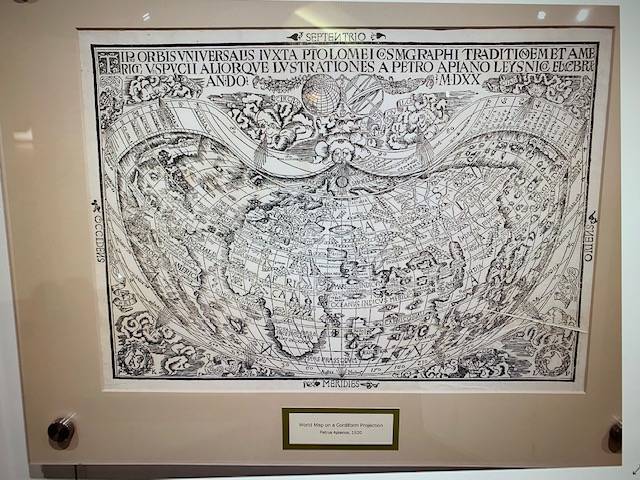
Earliest Obtainable Map to Name America
Cartographer:
Apianus, Petrus
Date of Creation:
1520
World Map on a Cordiform Projection, Petrus Apianus, 1520
Tipus Orbis Universalis IVXTA Ptolomei Cosmographi Traditionem et Americi Vespucci Aliorque Lustrationes a Petro Apiano Leysnico Elubrat. An. Do. 1520. From: Ionnis Camertis minoritani… ennarationes, Caius Julius Solinus, Vienna, 1520. Woodcut.
In 1507, the year following Columbus’ death, a group of humanists met in St. Die under the patronage of the Duke of Lorraine. Their goal was to review the new and often conflicting geographic data that had been compiled from the voyages of the preceding fifteen years. Most notable among the scholars, engravers, printers, and draftsmen was the eminent geographer Martin Waldseemüller.
Waldseemüller produced a radical new map of the world on twelve woodcut sheets. It depicted the New World as a distinct and autonomous part of the globe, with North and South America forming a nearly contiguous continent.
Since its depiction of America partitioned into two the ocean separating Europe from Asia, the map gave birth to the Pacific Ocean as a concept.
Waldseemüller had been studying a published letter purporting to detail four voyages to the New World by Amerigo Vespucci. The first voyage described Vespucci’s landfall on the South American mainland in 1497. As this was a year earlier than Columbus’ recorded discovery of the mainland, Waldseemüller dubbed the continent with the Florentine’s name.
In modern times, Waldseemuller’s map was known only through inference until the only extant copy was discovered in 1901. Whether or not the map was disseminated well enough in its own day to secure Vespucci’s immortality, its influence was secured through this adaptation done thirteen years later by Peter Apianus.
Much mystery surrounds Vespucci and his travels to the New World. One school of thought holds that Vespucci fabricated the first (historically most critical) and his fourth voyages, and that he at least exaggerated his role in the other two. Even early chroniclers, notably Las Casas and Herrera, accused Vespucci of fraud, of conniving to secure his own fame at Columbus’ expense. But other evidence suggests that although Vespucci’s 1497 voyage was indeed fictitious, the deceit was the invention of a profits-driven publisher, not Vespucci.
Waldseemüller, writing in the Cosmographiae Introductio, a booklet meant to accompany his 1507 map, explains his decision to christen the New World with Vespucci’s name:
[A] fourth part [of the earth] has been discovered by Amerigo Vespucci… inasmuch as both Europe and Asia received their names from women, I see no reason why anyone should justly object to calling this part Amerige, i.e., the land of Amerigo, or America.
