
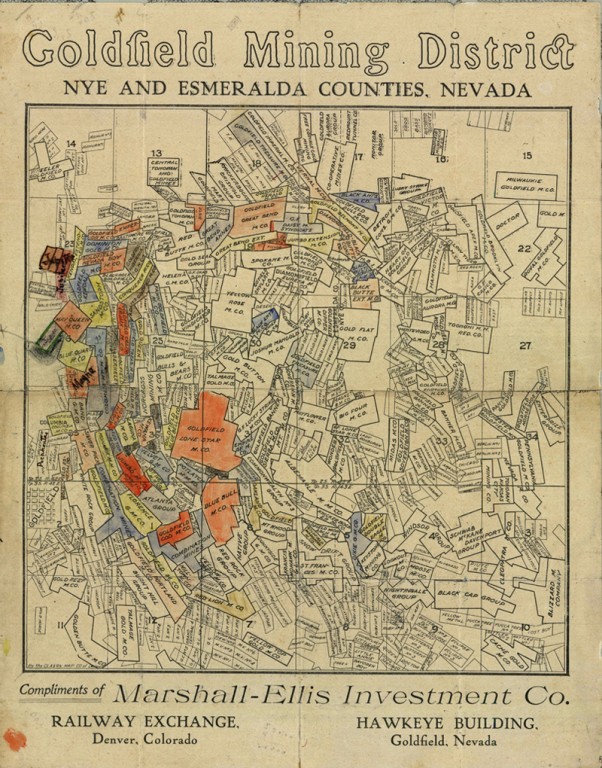
Goldfield Mining District: Nye & Esmeralda Counties, Nevada
Cartographer:
Griswold, R.W., after
Date of Creation:
after 1905
Issued as a broadside by Marshall-Ellis Investment Co., the Railway Exchange of Denver Colorado, and the Hawkeye Building, of Goldfield Nevada. Based on the map first published by Elmer J. Chute – Rand McNally of 1905 as a wall map and a pocket map. On this map three claims have been added to the west: the Pocahontas, Mayne and Jupiter. All three are listed in the 1909 edition of geological survey of Nevada.
Goldfield “was one of Southern Nevada's primary mining capitals, along with its neighbor, Tonopah [see herein], located 25 miles to the north. Tonopah's silver discovery in 1900 and Goldfield's gold strike in 1902 opened south and central Nevada to development. In the fall of 1902, Shoshone prospector Tom Fisherman brought a sample of ore he had found into Tonopah. Two other prospectors, Billy Marsh and Harry Stimler, decided to travel back to Goldfield with Fisherman who then discovered float gold on Columbia Mountain.They established a camp near the base of the mountain and christened it "Grandpa," believing it would be the granddaddy of all camps.... In April 1904, 'The Goldfield News' proclaimed that Goldfield was "the greatest camp ever known".... People flocked to Goldfield from all over the country looking to make their fortunes in this, the last of the great gold rushes, or just find work in the mines or in the many businesses in town. Goldfield continued booming in 1906; by the end of the year the population had reached 30,000” (University of Nevada online).
Between 1903 and 1905, growth in the Goldfield region of Nevada was exponential, as people rushed to find gold. Businesses, like the ones who sponsored this printing of the Griswold map, a luxury hotel, private baths and even a fancy restaurant serving oysters and squid burgeoned. The railway arrived in 1905. By 1906, the amount of ore taken out the ground was valued at approximately $15,000,000, and the population had reached an estimated 30,000.
In 1913, a flood destroyed much of the city. In 1918, the largest company ceased operations, and in 1923, a fire burned much of the town, effectively marking the end of the Goldfield mining venture.
